AI SEO vs Traditional SEO: How AI is Changing Search Rankings in 2026
Search engine optimization has been around for over two decades. But in 2026, the rules have shifted so dramatically that strategies which worked just three years ago are now actively hurting rankings. If you're still doing SEO the old way, you're not just falling behind — you're running in the wrong direction.
I had a client come to me last year with a website that had 200 backlinks, well-structured meta tags, keyword-dense content updated every month — all the traditional SEO boxes ticked. But their traffic had been declining steadily for 18 months. When we dug into what was happening, the answer was clear: Google's AI-driven ranking systems had fundamentally changed what "good content" means, and their site hadn't kept up.
That's the world we're operating in now. AI-powered SEO isn't a trend or a buzzword — it's the new baseline. And understanding how it differs from traditional SEO is the most important thing any business owner, marketer, or content creator can do in 2026.
What Traditional SEO Was Built On
For most of its history, SEO was a relatively mechanical discipline. You identified keywords people were searching for, built content around those keywords, earned backlinks from other websites, and made sure your technical setup — page speed, mobile-friendliness, structured data — was solid. Google's algorithm was complex, but it was fundamentally matching search queries to content that contained the right words in the right places.
Traditional SEO produced a very specific type of content strategy: target a high-volume keyword, write a long article that answers the query, build internal links, get backlinks, repeat. It worked. For years, businesses built substantial organic traffic this way. The agencies that mastered keyword research and link building were genuinely delivering value.
But here's what traditional SEO never really solved — content quality at scale. Because the algorithm was largely keyword-matching, it was possible to rank well with thin, repetitive content as long as the technical boxes were checked. And that created an internet full of content written for algorithms rather than actual human beings.
How AI Changed the Search Ranking Game
The shift started with Google's BERT update in 2019, accelerated through the Helpful Content System in 2022 and 2023, and by 2025–2026 has become the dominant reality of how search works. Google is no longer matching keywords — it's evaluating meaning, intent, expertise, and genuine usefulness using large language models baked directly into its core ranking systems.
At the same time, AI-generated search features — Google's AI Overviews, Bing's Copilot integration, and Perplexity-style AI search engines — have fundamentally changed what the search results page looks like. Instead of ten blue links, users increasingly see an AI-synthesized answer at the top, with source citations below. This means the question isn't just "can I rank on page one?" anymore — it's "can my content be the source that the AI cites?"
That's a completely different optimization target, and it requires a completely different approach.
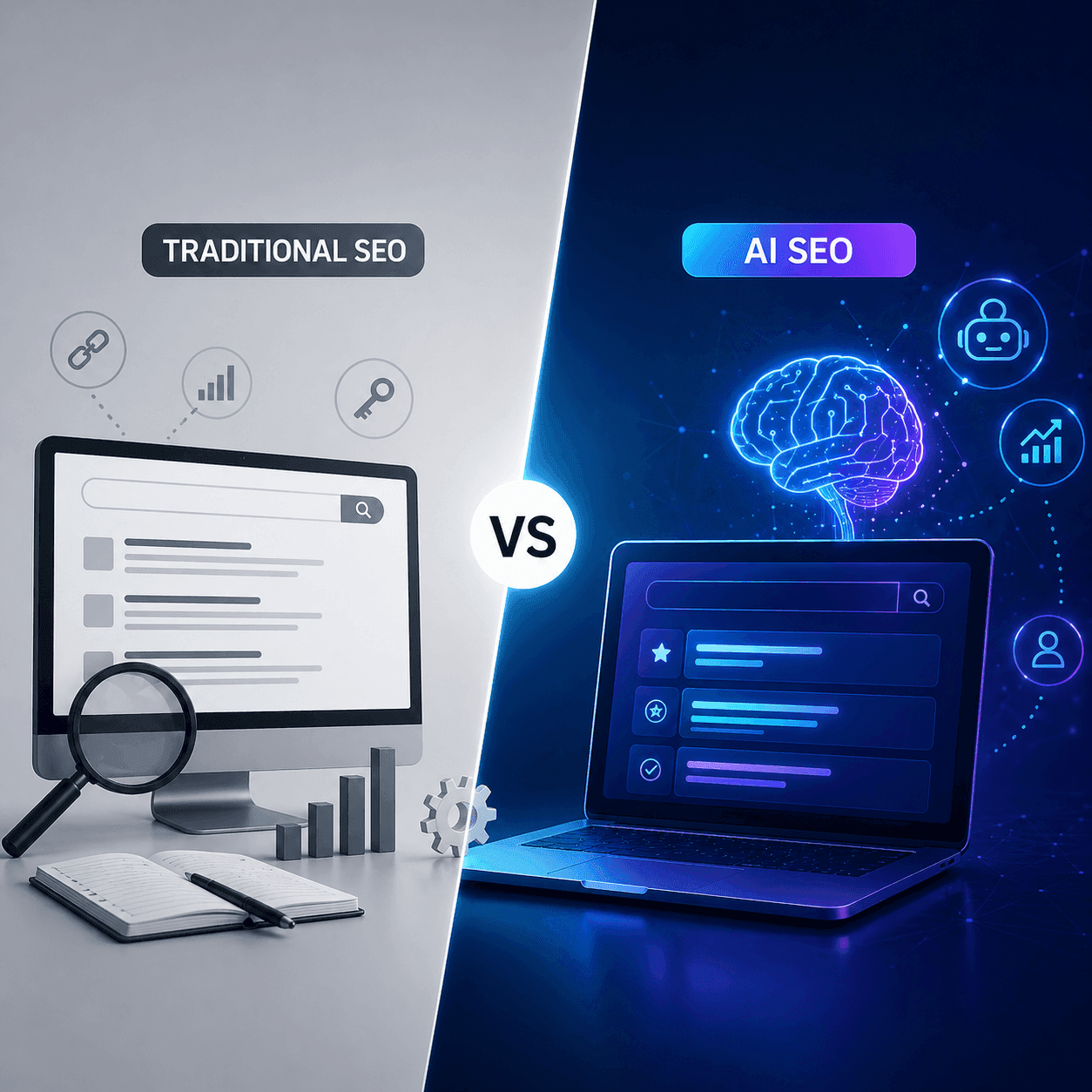
AI SEO vs Traditional SEO: Side by Side
| Factor | Traditional SEO | AI-Powered SEO |
|---|---|---|
| Core Focus | Keyword matching & density | Search intent & topical authority |
| Content Goal | Rank for a specific keyword | Become the trusted source on a topic |
| Link Building | Volume of backlinks matters most | Quality, relevance & authority of links |
| Content Length | Longer = better (word count focus) | Depth of insight matters more than length |
| Keyword Strategy | Target exact-match keywords | Cover semantic clusters & related queries |
| Author Expertise | Rarely considered | Critical — E-E-A-T signals |
| User Behavior Signals | Secondary factor | Primary ranking signal |
| AI Search Visibility | Not applicable | Essential optimization target |
| Content Freshness | Update periodically | Real-time accuracy & expert updates |
| Technical SEO | Core foundation | Still essential — but table stakes only |
The Biggest Shifts You Need to Understand
- Build content clusters around a single topic area
- Cover a subject comprehensively across multiple pages
- Internal linking that maps your expertise
- Google rewards sites that own a topic, not just a keyword
- Semantic relevance beats keyword repetition
- Target one primary keyword per page
- Optimize title tag, H1, meta description for that keyword
- Build as many backlinks as possible
- Update word count to match top-ranking competitors
- Focus on domain authority metrics
E-E-A-T: The Framework That Now Controls Rankings
If you haven't heard of E-E-A-T — Experience, Expertise, Authoritativeness, and Trustworthiness — this is the most important SEO concept to understand in 2026. Google's quality raters use this framework to evaluate content, and its signals feed directly into how AI ranking systems assess pages.
What this means practically: anonymous content written by nobody in particular, about everything in general, is increasingly invisible in search. Google wants to know who wrote this, what qualifies them to write it, and whether the site publishing it has a track record of accuracy. Author bios with credentials, first-hand experience demonstrated through specific examples, citations of real sources, and consistent publishing in a defined topic area — these are the signals that E-E-A-T rewards.
For businesses, this is actually good news. If you genuinely know your industry — if you've been doing it for years and have real client stories and real results — you have E-E-A-T signals that no AI content farm can replicate. The key is making those signals visible on the page, not just inside your head.
How AI Search Features Are Reshaping Click Behaviour
Google's AI Overviews now appear at the top of results for a growing percentage of informational searches. Bing Copilot synthesizes answers from multiple sources. Perplexity and similar tools are building a generation of users who expect an answer, not a list of links. This has created what SEO professionals are calling the zero-click search problem — users get their answer without ever visiting a website.
But here's the nuance that most people miss: the websites that Google's AI cites as sources in those overviews are getting a different kind of traffic — smaller in volume, but much higher in intent and conversion. If your content is cited as the source of an AI answer, the users who click through already trust you before they arrive. That changes the entire dynamic of what organic traffic is worth.
Optimizing to be cited by AI search — sometimes called AEO (Answer Engine Optimization) or GEO (Generative Engine Optimization) — is the frontier that forward-thinking SEO strategists are working on right now.
Many businesses have responded to the content demands of modern SEO by flooding their sites with AI-generated articles. This is a short-term tactic with a long-term cost. Google's systems are increasingly adept at identifying content that lacks genuine first-hand insight, real examples, and human perspective. Sites that built traffic on AI-generated content through 2023–2024 have seen significant ranking drops as Google's Helpful Content updates specifically target content made for search engines rather than people.
What an AI SEO Strategy Actually Looks Like in Practice
-
Build a Topic Cluster, Not a Keyword List
Pick one core topic your business owns — say, "CRM automation for small businesses." Then map out every question, subtopic, and related concept around it. Create a pillar page for the core topic and supporting articles for each cluster. This signals topical authority to Google's AI systems more powerfully than any individual keyword-optimized page.
-
Lead With Real Experience and Specific Examples
Every piece of content should contain something that only someone with actual experience could write — a specific client result, a mistake you made and corrected, a counterintuitive finding from real work. This is the E-E-A-T signal that AI ranking systems are looking for and that generic content cannot fake.
-
Optimize for Questions, Not Just Keywords
AI search systems are trained on natural language. They respond to content that directly and clearly answers specific questions. Structure your content with clear questions as subheadings, followed by concise and accurate answers. Use FAQ sections. Write the way a knowledgeable person actually explains things — not the way a keyword tool tells you to.
-
Make Author Expertise Visible
Every piece of content should have a named author with a bio that establishes their credentials in that topic area. Link to the author's other published work. If you have certifications, years of experience, or client results — put them on the page. Anonymous content is losing ground in every category in 2026.
-
Use Structured Data to Help AI Understand Your Content
Schema markup — FAQ schema, Article schema, HowTo schema, Review schema — helps search engines and AI systems parse what your content contains. Pages with proper structured data are significantly more likely to appear in rich results, AI overviews, and voice search answers. This is technical SEO that directly feeds AI visibility.
-
Track Visibility in AI Answers, Not Just Rankings
Traditional SEO tracked keyword rankings. AI SEO requires tracking whether your brand appears in AI-generated answers, which queries trigger your site as a cited source, and what featured snippets you hold. Tools like SearchGPT monitoring, Google Search Console's AI Overview data, and brand mention tracking are the new performance dashboard.
Does Traditional SEO Still Matter at All?
Absolutely — but its role has changed. Technical SEO is still the foundation: fast page speeds, clean site architecture, mobile optimization, proper crawlability, and Core Web Vitals all still matter because they determine whether Google can even access and evaluate your content. Backlinks still carry weight, but quality and relevance have overtaken volume. And keyword research is still necessary — you just use it to map intent and build topic clusters rather than to stuff individual pages.
Think of traditional SEO as the infrastructure and AI SEO as the strategy that runs on top of it. You need both. The businesses getting the strongest organic results in 2026 haven't abandoned technical best practices — they've added a layer of genuine expertise, human perspective, and AI-optimized content architecture on top of a solid technical foundation.
The businesses that understand this shift early and build their content strategy around it aren't just going to rank better — they're going to own categories. In a world where AI generates generic answers by default, the content that stands out is the content that could only have come from someone who actually knows what they're talking about.
That's always been the goal of good SEO. AI has just made it non-negotiable.