Courier Software in Bangladesh: Scale Your eCommerce Faster
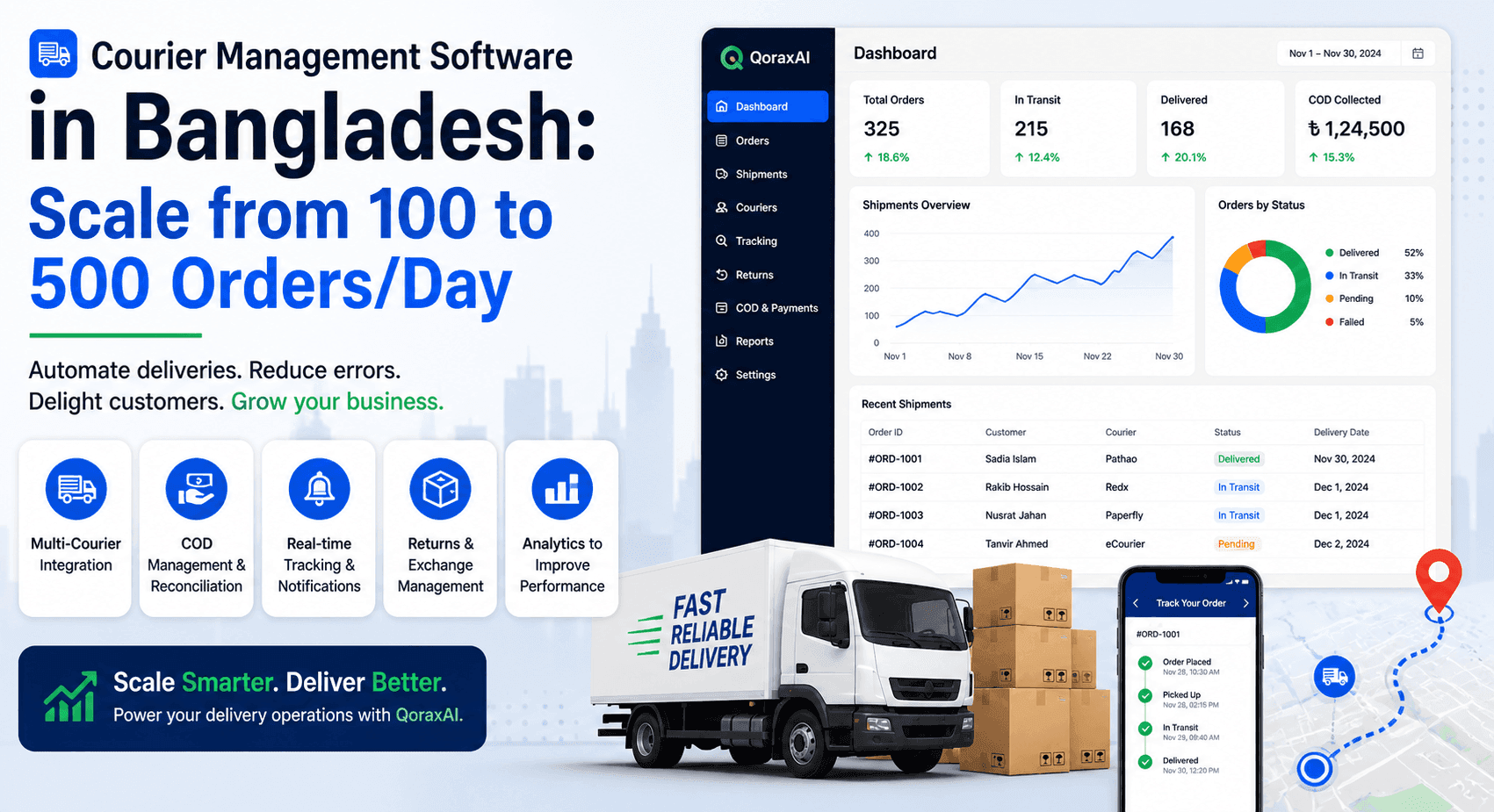
Bangladesh's eCommerce market is doubling every three years. The businesses that scale aren't the ones with the flashiest storefronts — they're the ones that figured out how to handle 500 orders a day without drowning in WhatsApp messages, missed pickups, and customer complaints about late deliveries.
I spoke with a fashion brand owner in Mirpur last year who was processing around 80–100 orders per day manually. She had a team of two managing orders through a mix of Facebook Messenger, a shared Google Sheet, and phone calls to three different courier services. Every morning started with an hour of copy-pasting tracking numbers. Every afternoon had at least one delivery dispute. By the time she came to us, she had already lost two key customers because of fulfillment errors that could have been prevented entirely.
The problem wasn't her product or her marketing. The problem was that she had built a business that could sell at scale but couldn't deliver at scale. And the missing piece was a proper courier management software — a system that connects her store, her couriers, her customers, and her team in one place.
If you're running an eCommerce business in Bangladesh and still managing deliveries manually, this guide covers everything you need to know before making a decision.
What Is Courier Management Software and Why Does It Matter?§01
Courier management software (CMS) is a platform that centralises everything related to your delivery operations — from order creation and courier booking to real-time tracking, proof of delivery, and COD reconciliation. Instead of juggling multiple tabs, WhatsApp threads, and spreadsheets, everything lives in one dashboard accessible to your whole team.
In the context of Bangladesh eCommerce, where cash on delivery (COD) still accounts for over 75% of all transactions and courier reliability varies significantly by zone, a proper CMS is not a luxury — it's operational infrastructure. The businesses processing 200+ orders daily without one are essentially running their logistics on goodwill and improvisation, and that ceiling hits fast.
"The courier isn't just the last step of the sale — it's the only part of your business your customer physically experiences. Get it wrong and all the great product photos and ad spend in the world won't save the relationship."
Core Features Every Bangladesh eCommerce Business Needs§02
Not all courier management platforms are built with the Bangladesh market in mind. Features that matter in European or US logistics software often miss the COD-heavy, multi-courier reality of local eCommerce. Here's what actually counts:
Bangladesh Courier Platforms: How They Compare§03
Part of what makes delivery management complex in Bangladesh is the fragmented courier landscape. Different services perform differently by zone, parcel size, and product category. A courier management system helps you route intelligently — but first you need to understand who the players are:
| Courier | Coverage | COD Support | API Available | Best For |
|---|---|---|---|---|
| Pathao Courier | Dhaka + 64 districts | Yes | Yes | Same-day Dhaka, fashion, small parcels |
| Paperfly | Nationwide | Yes | Yes | Nationwide SME eCommerce, mid-volume |
| Redx | Nationwide | Yes | Yes | High-volume merchants, competitive rates |
| eCourier | Nationwide | Yes | Yes | Documents, corporate, mixed parcel types |
| Steadfast | Nationwide | Yes | Yes | Growing merchants, affordable base rates |
| SA Paribahan | Nationwide (bus network) | Limited | No | Heavy parcels, outside urban centres |
| Sundarban Courier | Nationwide | Limited | No | Traditional network, strong rural reach |
Many eCommerce businesses in Bangladesh rely entirely on one courier service — usually because the initial setup was easier that way. This creates a single point of failure. When that courier has a bad week (and they all do eventually), your entire delivery pipeline stalls. A proper courier management system lets you route orders intelligently across multiple partners, so one courier's problems never stop your operations entirely.
How the Right CMS Reduces Costs and Increases Profit§04
The most common pushback I hear from business owners about investing in courier software is "we're not big enough yet." But the calculation usually reverses very quickly when you map out what manual delivery management is actually costing month by month.
Against that, a capable courier management platform for a 100-orders/day business in Bangladesh typically costs ৳2,000–৳8,000 per month depending on the solution and tier. The math is straightforward — and the ROI usually lands within the first four to six weeks.
What to Look for When Choosing Courier Software in Bangladesh§05
Must-Have Criteria for Local eCommerce Operations
- Direct API integrations with Pathao, Paperfly, Redx, Steadfast
- COD collection tracking and remittance reconciliation built in
- Bulk order upload from WooCommerce, Shopify, or custom stores
- Automated SMS/WhatsApp notifications in Bangla and English
- Return and exchange workflow with reason code tracking
- Zone-based courier routing — auto-select by delivery area
- Mobile app for warehouse and on-the-go management
- Delivery performance reports by courier, zone, and time period
- Weight and dimension-based shipping rate calculation
- Role-based access for warehouse, support, and admin teams
Integrating Courier Software with Your Full eCommerce Stack§06
A courier management system delivers the most value when it's connected to the rest of your operations — not sitting as a standalone island. Here's what a properly integrated eCommerce tech stack looks like for a Bangladesh seller in 2026:
When an order comes in through your store, it should flow automatically into your courier management system, get assigned to the right courier based on zone and current performance, trigger a pickup request, and send the customer a confirmation — all without anyone copying anything manually. When the parcel is delivered, COD payment gets logged, inventory updates, and a post-delivery message goes out automatically.
That's not a fantasy setup reserved for large enterprises. Businesses doing 150–200 orders a day in Bangladesh are running exactly this kind of integrated stack right now — and processing three to four times the volume with the same team size they had before.
After implementing a courier management system integrated with WooCommerce, Pathao, and Paperfly — with automated COD reconciliation and WhatsApp customer notifications — the business reduced daily order-processing time from 90 minutes to under 15 minutes. Delivery disputes dropped by 60%. COD remittance discrepancies went to near zero. The same team of two handled 180+ orders per day without adding headcount.
Common Delivery Mistakes Bangladesh eCommerce Businesses Make§07
Even with the right software in place, delivery operations break down when the operational fundamentals aren't right. These are the mistakes I see most consistently across Bangladesh eCommerce businesses at every stage of growth:
Not verifying addresses at order placement. Bangladesh addressing is notoriously inconsistent — missing thana details, incorrect postal codes, and vague landmark references cause a significant percentage of delivery failures. A simple address confirmation message before dispatch eliminates most of these before they happen. Your CMS should flag incomplete addresses automatically at the point of booking.
Relying on a single courier for all zones. No single courier performs equally well across all of Bangladesh. The best-run operations maintain active accounts with two or three couriers and route based on coverage maps and recent delivery success data. Your CMS should support automatic routing rules so that orders going to rural Sylhet take a different path than same-day Dhaka deliveries.
Not tracking COD float carefully. For businesses doing meaningful COD volume, there can be ৳3–5 lakh in transit with couriers at any given time. Without proper tracking and reconciliation, that money becomes difficult to account for — and disputes with couriers about missing remittances are extremely common. This is one of the most financially significant features in any courier management system for Bangladesh businesses, and it's often underappreciated until the first major discrepancy surfaces.
Treating returns as an afterthought. Return rates in Bangladesh eCommerce run anywhere from 8% to 25% depending on category. Businesses without a structured return workflow — with reason codes, condition logging, and automatic inventory reconciliation — lose significant product value in untracked damage and misprocessed refunds. Returns handled manually are also a leading source of customer relationship damage.
Getting Started: The Practical Path Forward§08
If you're managing deliveries manually today and processing more than 30–40 orders per day, the return on investment from courier management software is immediate and measurable. Start by mapping your current pain points clearly — is it COD reconciliation, tracking visibility, return management, or customer communication breakdowns? That tells you which features to prioritise when evaluating platforms.
Most platforms offer a trial period or a low-volume free tier. Use it with real orders for two to three weeks, measure the time saved per day and the reduction in disputes, and let the numbers guide the decision. A platform that saves two hours of manual work per day has paid for six months of subscription in the first week alone.
The eCommerce businesses scaling fastest in Bangladesh right now — the ones going from 100 to 500 orders per day without proportionally growing their teams — have all solved this operational layer. Not because courier management software is exciting, but because a business that can't reliably deliver what it sells cannot sustainably grow, no matter how good the marketing is.
From courier management software selection and integration to full eCommerce automation — connecting your store, your couriers, your CRM, and your customer communications into one seamless system that runs without manual intervention.
- Courier platform evaluation and integration for Bangladesh businesses
- WooCommerce / Shopify + courier API setup and full testing
- COD reconciliation workflows and financial tracking setup
- WhatsApp Business API and SMS notification automation
- Return management system design and implementation
- Zoho CRM + courier data integration for customer service teams