Database Optimization Services in Bangladesh: Improve Speed, Performance & Scalability
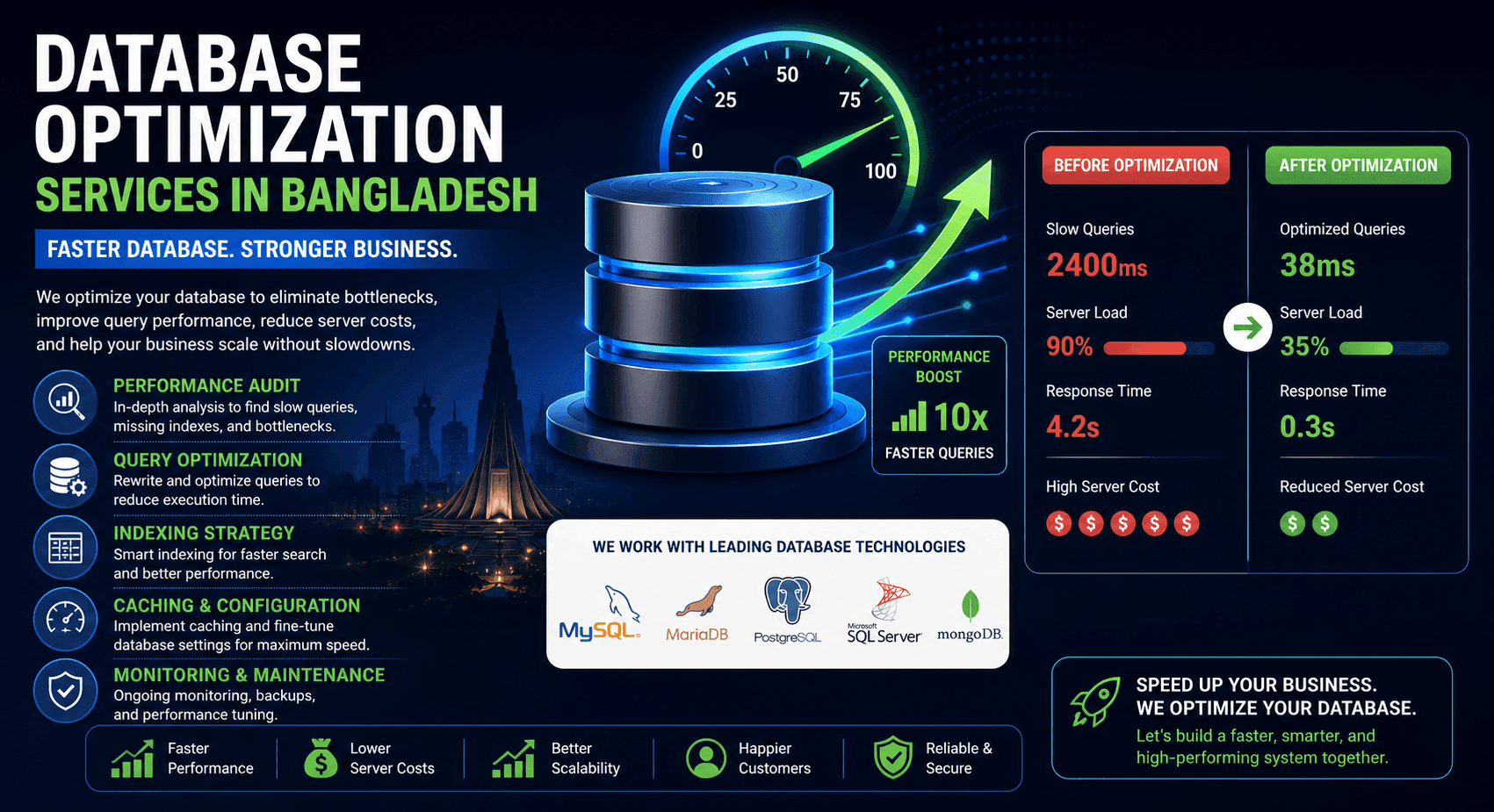
Your application isn't slow because you need better servers. In most cases, it's slow because nobody has looked at what's happening inside the database. That single oversight is costing Bangladesh businesses millions of taka in lost productivity, failed transactions, and customers who never come back.
A few months back I was brought in to look at an e-commerce platform in Dhaka. The site was running on decent cloud infrastructure, the frontend was clean, and the development team was competent. But checkout was timing out during peak hours. Cart abandonment had climbed to 71%. Customer complaints were piling up. The management had already spent a significant budget on server upgrades — and nothing had improved.
We ran a database diagnostic in the first hour. The results told the whole story. Missing indexes on the orders table. N+1 query patterns in the product search logic. No query caching layer. A single unoptimized reporting query locking tables for up to 8 seconds during business hours. The database was choking on its own workload — and every taka spent on bigger servers was being wasted because the root cause was never addressed.
This is not an unusual story. It is, in fact, the most common performance problem I encounter in businesses across Bangladesh right now.
Why Database Performance Is a Business Problem, Not Just a Technical One
Most business owners think of database optimization as something that belongs in the IT department — a technical concern that doesn't touch the P&L. That's one of the most expensive misconceptions in modern business operations.
Every customer-facing delay is a lost conversion. Every report that takes two minutes to load is two minutes of a decision-maker's time wasted. Every system crash during peak hours is a direct hit to revenue and reputation. When a restaurant's POS system freezes during lunch rush, when a hospital's patient records take 12 seconds to load, when a logistics company's dispatch system lags — those aren't tech problems. Those are business problems with a technical root cause.
And the root cause, in the overwhelming majority of cases, is a database that was set up once and never properly maintained, tuned, or optimized as the data grew and the usage patterns evolved.
What Database Optimization Actually Involves
Database optimization is not a single action — it's a discipline that covers multiple layers of how data is stored, retrieved, and managed. Here's what a proper optimization engagement covers in practice:
The Core Areas of Database Optimization
Every database accumulates poorly written queries over time — especially as applications grow and teams change. A full slow query audit identifies which queries are consuming the most resources, rewrites them for efficiency, and eliminates patterns like N+1 queries that silently destroy performance at scale. This single step typically produces the most dramatic speed improvements.
Indexes are the single most impactful performance lever in relational databases. A missing index on a frequently queried column can mean the difference between a 30ms response and a 4-second full table scan. Proper indexing strategy covers which columns to index, when to use composite indexes, and how to balance read speed against write overhead — because over-indexing is also a real problem.
Bad schema design is often baked in from the beginning and compounds over years. Tables that store too much in a single column, relationships that were never properly defined, data types that were chosen for convenience rather than efficiency — all of these create cascading performance problems. A schema review identifies structural issues and maps out a migration path that improves performance without disrupting live operations.
Not every query needs to hit the disk every time. Implementing a proper caching layer — whether Redis, Memcached, or database-level query caching — means that frequently requested data is served from memory at microsecond speed rather than executing a fresh database read each time. For high-traffic applications, this can reduce database load by 60–80%.
MySQL, PostgreSQL, MariaDB, and MongoDB all ship with default configurations designed to work on minimal hardware. Almost every production database is running on hardware significantly more capable than those defaults assume. Tuning buffer pool sizes, connection limits, I/O scheduler settings, and memory allocation to match your actual hardware profile can improve performance by 30–50% without touching a single query.
Optimization isn't a one-time event — databases grow, query patterns shift, and new bottlenecks emerge. Establishing automated monitoring, alerting on slow queries and connection spikes, and scheduling regular maintenance tasks (index rebuilding, statistics updates, log rotation) ensures that performance gains are maintained over time rather than silently degrading.
Before and After: What Optimization Changes
- Product search taking 3–8 seconds on large catalogues
- Reports timing out or requiring manual exports
- Peak-hour crashes from connection pool exhaustion
- Full table scans on every lookup query
- Identical queries hitting disk hundreds of times per minute
- Database server CPU consistently above 80%
- Backup jobs conflicting with live traffic
- No visibility into what's actually causing slowdowns
- Sub-100ms query response times for indexed lookups
- Real-time dashboards and reports loading instantly
- Stable performance under 5× the previous peak load
- Targeted index hits replacing expensive full scans
- Cache layer serving 70%+ of repeated queries from memory
- Database CPU consistently below 30% under normal load
- Scheduled maintenance running during off-peak windows
- Monitoring alerts catching issues before users notice them
Industries in Bangladesh Where Database Performance Is Critical
Every data-driven business eventually hits database performance limits — but certain industries in Bangladesh are feeling this pressure most acutely right now, as digital adoption accelerates and data volumes grow faster than infrastructure planning has kept up with.
The Hidden Cost of Ignoring Database Performance
Most businesses don't budget for database optimization because they don't see it as a revenue item. But the costs of not optimizing are very real — they just show up in less obvious places.
Customer churn is the most direct. Users who encounter slow load times, failed transactions, or system errors rarely send a complaint — they just leave and don't come back. In a competitive market, a checkout experience that's two seconds slower than a competitor's is a meaningful conversion killer.
Oversized infrastructure bills are the second cost. When a database is inefficient, it consumes far more server resources than it should. Many businesses are running on servers three or four times larger than they need because their database is doing ten times more work than necessary. Optimization routinely cuts infrastructure costs by 30–50% — often paying for the engagement entirely within the first few months.
And then there's developer productivity. When applications are slow, developers spend time debugging performance issues, writing workarounds, and managing incidents. That's time not spent building features or serving customers. A well-optimized database reduces this ongoing drag significantly.
After a full database optimization engagement — slow query rewrite, indexing overhaul, Redis caching layer, and MariaDB configuration tuning — average page load time dropped from 4.2s to 0.38s. Checkout timeout errors went from daily occurrences to zero. Monthly server costs reduced by 44%. The engagement paid for itself in the first 6 weeks through recovered conversion revenue alone.
Choosing the Right Database Optimization Partner in Bangladesh
Database work requires a specific combination of skills that's genuinely rare — deep SQL expertise, understanding of the application layer generating the queries, experience with the specific database engine in use (MySQL, PostgreSQL, MariaDB, MongoDB, SQL Server), and the operational experience to make changes safely on live production systems without causing downtime.
Before engaging any service provider, ask them three things: Can they show you a diagnostic process before proposing solutions? Do they have experience with databases of your size and your specific engine? And can they provide a staged optimization plan that allows rollback at each step? No serious database professional should be making irreversible changes to a production system without a tested rollback strategy.
The best engagements start with a non-intrusive audit — read-only diagnostic queries that identify the biggest performance bottlenecks without touching any data or configuration. That audit report alone should give you a clear picture of where the problems are and what fixing them is worth.
If your application is slower than it should be, your server bills are higher than they seem justified, or your team is spending significant time managing database-related incidents — those are the signals that a proper database optimization engagement is overdue.
The technology that runs your business deserves the same attention as the business itself. A database that's been properly optimized isn't just faster — it's a more stable, more cost-efficient foundation for everything built on top of it. And in a market moving as fast as Bangladesh's digital economy in 2026, that foundation matters more than most people realize until it starts failing.