ERPNext vs Odoo vs SAP: Which ERP is Best for Your Business?
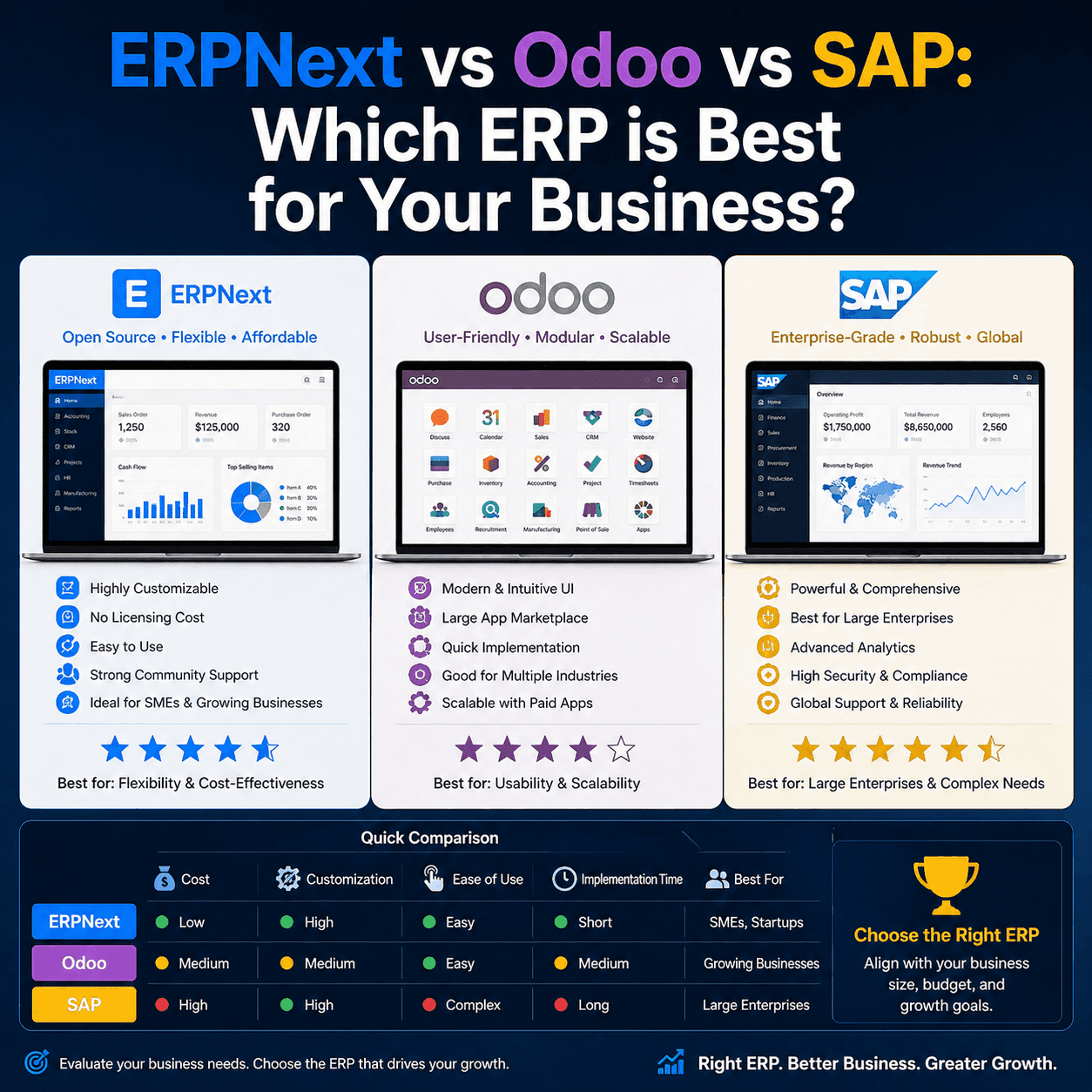
Last year, I was sitting across from a factory owner in Dhaka who had just paid a consultant six figures to start an SAP implementation. Eight months in, the project had stalled, his team was frustrated, and half the modules still weren't live. Meanwhile, a similar business two streets away was running smoothly on ERPNext — fully operational in under three months, at a fraction of the cost.
That contrast stuck with me. The right ERP can transform your operations. The wrong one can drain your budget, burn out your team, and leave you worse off than spreadsheets. So if you're sitting here wondering whether to go with ERPNext, Odoo, or SAP — this is the honest breakdown you need before making that call.
Why Choosing the Right ERP Matters More Than Ever
Enterprise resource planning software isn't just accounting software anymore. A modern ERP system touches everything — your inventory, your purchasing, your HR, your CRM, your manufacturing floor, your financial reports. Get the fit right and your business runs like a machine. Get it wrong and you're paying for a system your team ignores while doing real work in WhatsApp groups and Excel.
The global ERP market is projected to exceed $78 billion by 2026, and businesses of all sizes are actively evaluating their options. The three names that come up most consistently for small-to-mid-size businesses are ERPNext, Odoo, and SAP S/4HANA. Each has genuine strengths. Each has real limitations. The decision almost always comes down to your company size, budget, and how much customization you actually need.
A Quick Look at Each Platform
- 100% open source, MIT licensed
- Built on Python + MariaDB (Frappe framework)
- Strong manufacturing & inventory modules
- Active global community
- Self-host or use Frappe Cloud
- Best for: SMEs, startups, NGOs
- Modular — pay for what you use
- Slick UI, easy onboarding
- Strong eCommerce & CRM integration
- Community edition is free but limited
- Enterprise pricing adds up fast
- Best for: Growing SMEs, retail, services
- Industry leader for 50+ years
- Deep compliance & reporting features
- Handles massive transaction volumes
- Steep learning curve
- High licensing + implementation cost
- Best for: Large enterprises, regulated industries
ERPNext vs Odoo vs SAP: Head-to-Head Comparison
| Factor | ERPNext | Odoo | SAP S/4HANA |
|---|---|---|---|
| Pricing Model | Free (self-host) / Cloud from $50/mo | Free community / Enterprise from $31/user/mo | $1,500–$3,000+/user/year |
| Implementation Cost | Low | Medium | Very High |
| Ease of Use | Moderate learning curve | Beginner-friendly UI | Complex, requires training |
| Customization | Highly customizable (open source) | Good via Studio (Enterprise only) | Customizable but expensive |
| Modules Available | Accounting, HR, CRM, Mfg, Inventory, Projects | 30+ modules across all business areas | Full enterprise suite |
| Best Company Size | 1–500 employees | 10–1,000 employees | 500+ employees |
| Self-Hosting Option | Yes, fully supported | Community edition only | Cloud-first, complex on-prem |
| Open Source | 100% Open Source | Partially (Community) | Proprietary |
| Go-Live Timeline | 4–12 weeks (SME) | 6–16 weeks | 6–18 months |
| Community & Support | Strong open-source community | Large community + paid support | Official SAP support (expensive) |
ERPNext — The Underdog That Punches Above Its Weight
ERPNext gets underestimated a lot, mostly by people who associate "free and open source" with "limited." That assumption is wrong. ERPNext covers accounting, stock management, manufacturing, HR and payroll, CRM, project management, and even a helpdesk — all out of the box. No per-module pricing. No hidden fees for features you'd expect as standard.
What makes ERPNext particularly attractive for businesses in South Asia, Southeast Asia, and emerging markets is the total cost of ownership. You can self-host on a $20/month VPS, manage your own server, and pay a local developer or implementation partner for customizations. Compared to what SAP would bill you just for a support call, it's a completely different universe financially.
That said, ERPNext isn't plug-and-play. The initial setup — especially if you're self-hosting — requires some technical confidence. Server configuration, bench setup, SSL certificates, and database management are real considerations. But once it's live and configured for your workflows, it's remarkably stable and capable. I've set it up for manufacturing companies running 200+ transactions a day without a hitch.
ERPNext is the right choice if:
You're a small-to-medium business that wants enterprise-grade features without enterprise-level pricing. If you have a team of 5 to 250 people, solid processes, and either in-house technical resources or a good implementation partner — ERPNext will serve you extremely well. It's especially strong for manufacturing, trading companies, NGOs, and educational institutions.
Odoo — The Beautiful Middle Ground
Odoo has done something really smart over the past decade — it positioned itself as the ERP system for businesses that want something that actually looks good and is easy to use. The interface is clean, the onboarding is straightforward, and the modular structure means you can start with just CRM or just inventory, then add more as you grow.
The community edition of Odoo is genuinely useful, but the moment you need multi-company support, advanced reporting, or the Studio customization tool, you're pushed into the Enterprise tier. And those per-user fees add up surprisingly fast. A 50-person company using Odoo Enterprise across core modules could easily be looking at $25,000–$40,000 per year in licensing alone — before implementation costs.
Odoo also shines for businesses with heavy eCommerce activity. The native integration between Odoo's website builder, online shop, inventory, and accounting is genuinely seamless in a way that ERPNext doesn't quite match yet. If your business sells online and needs everything connected in one place, Odoo's ecosystem is hard to beat at the mid-market level.
Odoo is the right choice if:
You're a growing business in retail, services, or eCommerce that values ease of use and a polished interface and has a budget for Enterprise licensing. It's also a good fit if you want a phased rollout — starting with one or two modules before expanding.
SAP S/4HANA — The Gold Standard Nobody Small Can Actually Afford
SAP is the undisputed leader in enterprise ERP. There's a reason it powers over 400,000 businesses globally, including most of the Fortune 500. The depth of its financial compliance tools, multi-currency handling, supply chain management, and industry-specific modules is genuinely unmatched at scale.
But here's the honest truth: SAP is not designed for small and medium businesses, no matter what the sales pitch says. The licensing alone starts at a level that's out of reach for most SMEs, and that's before you factor in a certified SAP implementation partner — which you will need, because SAP implementations are notoriously complex. The average SAP S/4HANA implementation for a mid-size company takes 9 to 18 months and costs anywhere from $500,000 to several million dollars when all is said and done.
SAP has tried to address this with SAP Business One (aimed at SMEs) and the SAP Business ByDesign cloud product, which are more affordable — but even these require significant commitment compared to ERPNext or Odoo.
SAP is the right choice if:
You're a large enterprise with complex compliance requirements, multi-country operations, high transaction volumes, and a dedicated IT team. If you're publicly listed, operate in a regulated industry like pharma or banking, or have operations across multiple countries with different tax jurisdictions — SAP's depth justifies its cost.
The Hidden Costs Nobody Talks About
Every ERP decision comes with hidden costs that rarely appear in the initial quote. Training is one of the biggest — your team needs to actually learn the system, and that takes time away from their day jobs. Then there's data migration: moving years of customer records, inventory data, and financial history into a new system is always messier and more time-consuming than expected.
Customization is another silent budget killer. Most businesses have workflows that don't perfectly match out-of-the-box ERP configurations, and every customization adds development hours. With ERPNext, you can do this affordably because the codebase is open and developers are widely available. With SAP, the same customization might require a certified SAP consultant billing at $200–$400 per hour.
And finally — ongoing maintenance. Who manages updates? Who handles issues when something breaks at 11pm before payroll runs? These are operational realities that need a clear answer before you sign any contract.
My Honest Recommendation After Implementing All Three
Having set up ERPNext for manufacturing clients, evaluated Odoo for retail businesses, and observed SAP implementations up close — my take is pretty straightforward.
For 95% of small and medium businesses, ERPNext delivers everything they need at a price point that makes sense. It's not glamorous, the UI is functional rather than beautiful, and it takes effort to configure properly — but the value-to-cost ratio is unmatched in the ERP world right now. The open-source community is active, the documentation is solid, and with the right implementation partner, you can be live and productive in 6–10 weeks.
If budget isn't a concern and your team needs the cleanest onboarding experience possible, Odoo Enterprise is the premium mid-market option. Just go in with clear eyes about the licensing costs.
And if you're a 500+ person company with complex global operations and a large IT budget? SAP is probably where you'll end up anyway — just make sure your implementation partner has done it before and you have executive sponsorship from day one.
The worst ERP decision isn't picking the wrong software — it's picking software without understanding your own processes first. Before you shortlist any vendor, document how your business actually works today. Map your key workflows. Identify where data gets lost. Then match a system to those realities, not the other way around.
If you're evaluating ERPNext for your business or need help with implementation and configuration, feel free to reach out. Getting the foundation right at the start saves enormous headaches down the line.