Top 5 AI Web App Ideas for Garments & RMG Businesses in Bangladesh
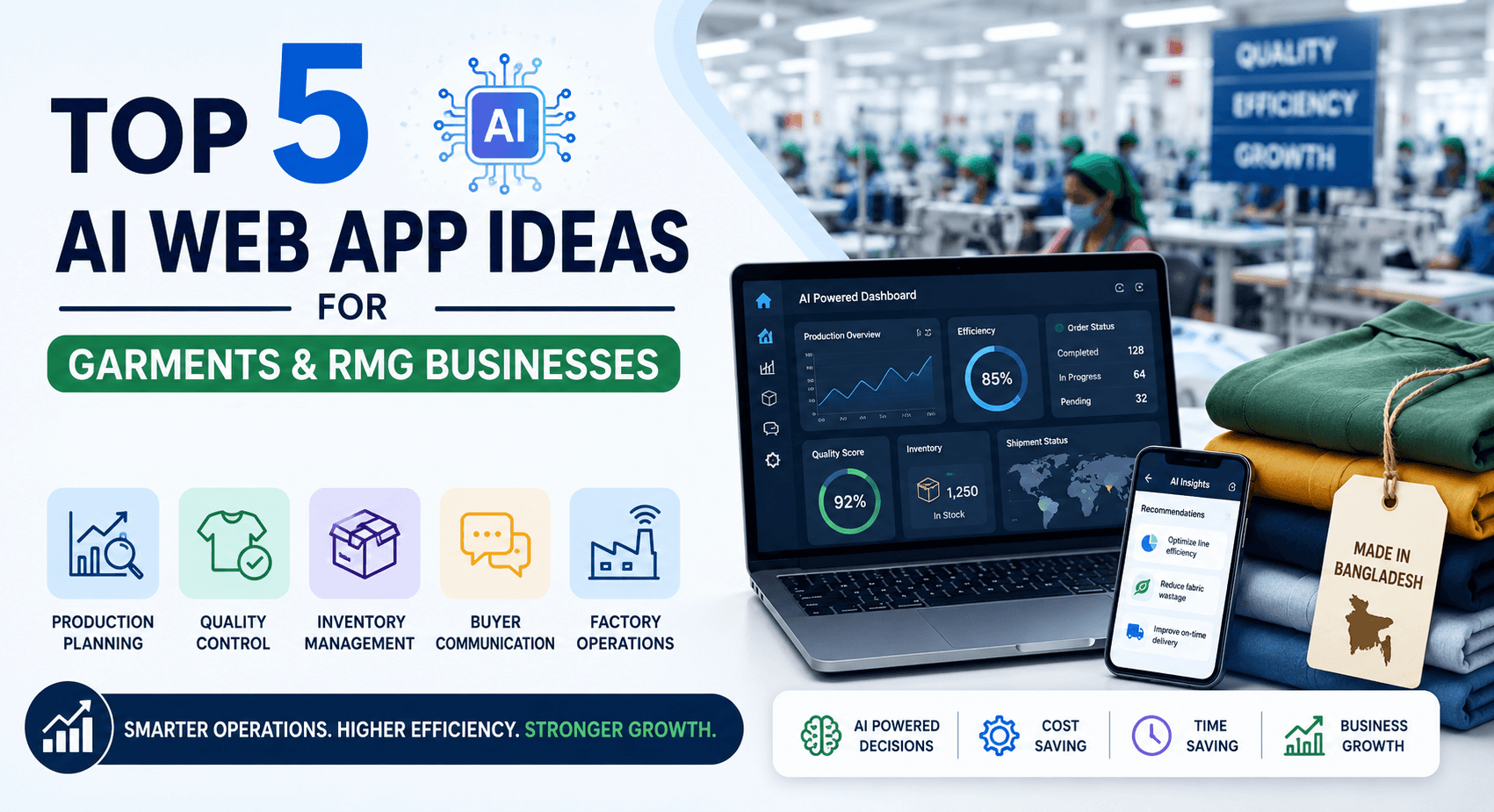
Bangladesh's garment industry employs over 4 million workers and generates $46 billion in exports annually. The factories that will lead the next decade are the ones adopting smart web applications right now.
Bangladesh's Ready-Made Garments (RMG) sector is the backbone of the national economy — the second-largest garment exporter in the world, trailing only China. It contributes nearly 84 percent of the country's total export earnings and supports the livelihoods of millions of families across Dhaka, Chittagong, Gazipur, and Narayanganj. But in 2026, the industry faces a defining moment.
Global buyers are demanding faster turnaround times, tighter compliance standards, and more transparency across supply chains. Labor costs are rising in relative terms. Competitors in Vietnam, India, and Cambodia are rapidly modernizing their operations. In this environment, the garment factories and buying houses that thrive will not simply be the ones with the lowest stitch cost — they will be the ones that are smarter, faster, and more data-driven than everyone else.
Artificial intelligence-powered web applications are at the center of that shift. And the good news for Bangladeshi entrepreneurs and factory owners is that many of the most impactful AI web app ideas for the RMG sector are not theoretical futures — they are buildable today, with practical return on investment that pays for itself within months, not years.
Why AI Matters for Bangladesh's Garments Sector
For years, technology adoption in the RMG industry moved slowly. Many factories still rely on spreadsheets for production planning, paper-based systems for quality control, and phone calls for buyer communication. While this worked when the competitive landscape was simpler, it creates serious vulnerabilities today.
AI web applications are not about replacing workers or making sweeping overnight changes. They are about giving factory managers, production planners, compliance officers, and business owners better information — faster — so that decisions improve, waste decreases, and output quality rises. The result is an operation that wins more orders, delivers on time, and builds the kind of buyer trust that creates long-term business relationships.
Below are five high-impact AI web app ideas specifically designed for the challenges and opportunities that Bangladesh's garment and RMG businesses face today.
Factories that adopt data-driven production tools see, on average, a 22% reduction in rework costs and a 17% improvement in on-time delivery rates within the first year of implementation.
— McKinsey Global Institute, Apparel Manufacturing ReportAI-Powered Production Planning & Line Balancing Tool
One of the most painful — and expensive — problems in garment manufacturing is poor production line balancing. When some workstations are overwhelmed while others sit idle, throughput suffers, overtime costs balloon, and delivery deadlines get missed. In many Bangladeshi factories, line supervisors still make balancing decisions manually based on experience and guesswork.
An AI-powered production planning web application can change this entirely. By ingesting historical production data, current order details, worker skill profiles, and machine capacity, the application can generate optimized line layouts that maximize throughput for each specific style or order. It can simulate different scenarios — what happens if three sewing operators are absent? What if the fabric is delayed by two days? — and recommend real-time adjustments before small problems become costly crises.
For factories running five to fifteen production lines simultaneously, this kind of smart planning tool can reduce production lead times by 15 to 25 percent and bring down work-in-progress inventory significantly. The web-based format means floor supervisors, production managers, and factory directors all access the same real-time data — eliminating the communication gaps that currently cost time and money every single day.
Key SEO terms this app targets: garment production planning software Bangladesh, RMG line balancing tool, factory management system Bangladesh, sewing line optimization app.
AI Defect Detection & Quality Management System
Quality rejections are among the most damaging financial events in the RMG business. When a shipment reaches a buyer with defect rates above tolerance, the consequences range from costly rework to chargebacks to, in serious cases, the loss of the buyer relationship entirely. For most Bangladeshi factories, quality inspection still depends on human inspectors checking a sample percentage of output at end-of-line — a method that catches problems late and inconsistently.
An AI-powered quality management web application integrated with basic camera hardware on the production floor can detect fabric defects, stitching anomalies, measurement deviations, and color inconsistencies in real time, flagging issues before they travel further down the line. Even without computer vision hardware, a well-designed AI web app can track defect data entered by checkers, identify patterns — which machine, which operator, which fabric lot, which time of shift — and surface the root causes of quality problems before they compound.
For compliance-focused buyers in Europe and North America who regularly audit factory quality systems, having a digital, data-backed quality trail is increasingly a requirement, not a preference. A web-based quality management system gives Bangladeshi factories the documentation infrastructure that global buyers now expect as standard.
Smart Fabric & Trim Sourcing Intelligence Platform
Raw material procurement — fabric, thread, buttons, zippers, labels, and packaging — accounts for 60 to 70 percent of total production costs in most RMG businesses. Yet in the majority of Bangladeshi buying houses and factories, sourcing decisions are still made through personal relationships, phone negotiations, and paper quotations. Price benchmarks are informal. Supplier performance is not tracked systematically. And fabric procurement managers carry critical supplier knowledge entirely in their heads.
A smart sourcing intelligence web application built for the Bangladesh garments industry would centralize supplier databases, track price histories for key fabrics and trims, monitor supplier delivery performance, and use AI to flag price anomalies or suggest alternative vendors when preferred suppliers cannot meet demand. It could integrate with yarn price indices and global commodity markets to give procurement managers real context around the prices they are being quoted.
For mid-to-large garment manufacturers sourcing from dozens of suppliers simultaneously, this kind of platform can reduce procurement costs by five to twelve percent annually — a substantial margin improvement in an industry where net margins are often measured in single digits. It also creates an institutional knowledge base that survives staff turnover, one of the most persistent operational risks in the Bangladesh RMG sector.
ESG Compliance & Sustainability Reporting Web App
In 2026, environmental, social, and governance (ESG) compliance is no longer a topic only the largest brands care about. European Union trade regulations, including the Corporate Sustainability Due Diligence Directive (CSDDD), are now pushing sustainability reporting requirements down the supply chain to Tier 1 and Tier 2 suppliers. Major buyers including H&M, Zara, and PVH are actively measuring and publishing the environmental performance of their sourcing partners.
For Bangladeshi RMG factories, this creates both a compliance burden and a genuine business opportunity. Factories that can demonstrate strong ESG performance with data — carbon emissions per garment, water consumption, chemical usage, worker welfare metrics, fire safety compliance scores — have a tangible competitive advantage when competing for orders from responsible sourcing programs.
An AI-driven ESG compliance and sustainability reporting web application tailored for Bangladesh's RMG sector could automate data collection across energy meters, water systems, and chemical inventories, generate buyer-ready sustainability reports in standard formats (GRI, Higg Index, ZDHC), track corrective action plans from audit findings, and benchmark factory performance against industry peers. This is the kind of tool that turns compliance from a cost center into a sales tool.
AI Merchandising & Buyer Communication Hub
In the buying house and merchandising business, relationships and responsiveness are everything. Buyers in New York, London, Stockholm, or Seoul judge their Bangladesh sourcing partners heavily on how quickly they respond to technical pack queries, how accurately they track sample development, and how proactively they communicate about any shipment or production risks.
An AI-powered merchandising and buyer communication web application could transform how Bangladeshi buying houses and factory merchandising teams manage the critical path from order placement to shipment. The platform would centralize all buyer communication, auto-generate status updates, track sample approvals and rejections, flag critical path milestones at risk of being missed, and use AI to draft professional buyer-facing emails and reports that meet the communication standards of top-tier international brands.
With multilingual support — English communication for international buyers, Bangla interfaces for internal teams — and WhatsApp or email integration for real-time alerts, this kind of platform addresses one of the most consistent criticisms international buyers have of Bangladesh sourcing partners: communication gaps and late information. Solving that problem, consistently, builds the kind of buyer trust that translates into repeat orders and growing business volume year after year.
The factories of the future in Bangladesh will not just sew faster — they will think smarter. AI web applications are the tools that make that possible.
How to Get Started with AI Web Apps in Your RMG Business
The common hesitation among garment factory owners and buying house directors considering digital transformation is the assumption that it requires large upfront investment, lengthy implementation timelines, and specialized technical teams. In reality, the best AI web applications for the RMG sector are built to be practical from day one.
Start with One Pain Point
Pick the most expensive or persistent operational problem you face and solve that first. Results build confidence and justify further investment.
Choose Web-Based Solutions
Cloud-based web apps require no hardware installations, scale easily across factory locations, and allow remote access for management teams.
Prioritize Mobile Compatibility
Floor supervisors and field teams need tools that work on smartphones. Mobile-first design is essential for real adoption in production environments.
Measure ROI From Week One
Set clear baseline metrics before launch — rework rate, on-time delivery percentage, sourcing cost per unit — and track improvement monthly.
Bangladesh's RMG sector has built a global reputation through hard work, scale, and competitive pricing. The next phase of that reputation will be built on intelligence — data-driven operations, transparent supply chains, and supplier relationships grounded in consistent communication and reliable delivery. AI web applications are not the destination. They are the vehicle.
For entrepreneurs and technology developers in Bangladesh, this moment represents one of the most significant business opportunities in the country's digital economy. The market is large, the need is urgent, and the factories that adopt smart tools early will create switching costs that protect their buyer relationships for years. Whether you are a factory owner exploring digital tools, a startup founder considering the RMG tech space, or a buying house director looking to differentiate, the five AI web app ideas above are worth serious attention — and serious investment.
Final Takeaway
Bangladesh's garments and RMG industry is at a crossroads between traditional manufacturing and technology-led competitiveness. AI-powered web applications in production planning, quality management, smart sourcing, ESG compliance, and buyer communication represent the clearest path to sustainable growth in a market where the bar for buyers keeps rising. The businesses that invest in these tools today will define who leads the Bangladesh RMG sector tomorrow.