Why Your Website Is Invisible in AI Search Results
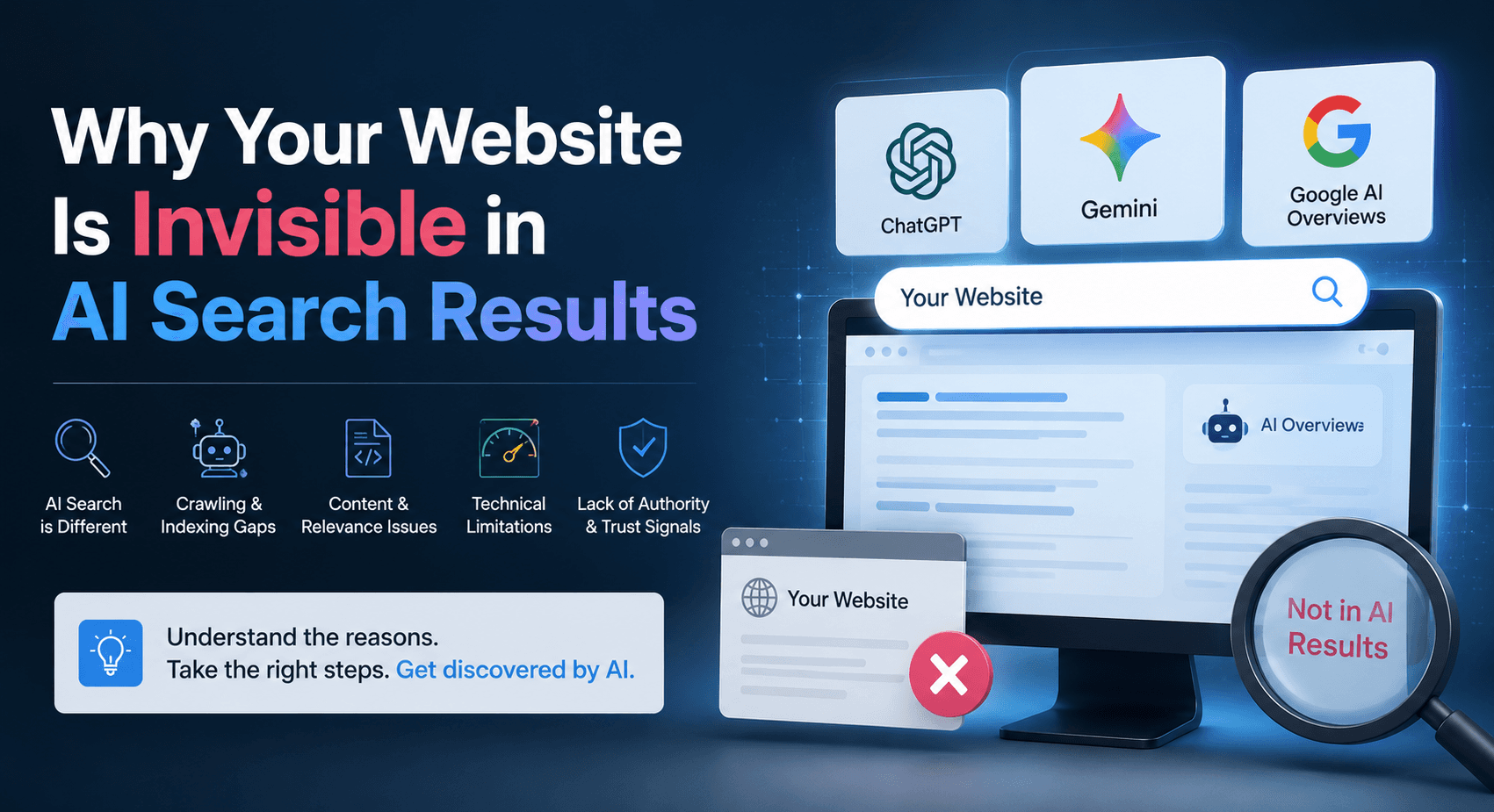
Open ChatGPT right now. Type in the service your business provides, followed by your city. Read the answer it gives. If your business is not mentioned — not cited, not referenced, not even implied — you are invisible to a search channel that is already influencing your customers' decisions. That silence is not neutral. It is costing you business every single day.
There is a specific kind of invisibility that feels impossible to diagnose. Your website is live. Your Google rankings look decent. Your team is publishing content. And yet something is wrong — enquiries are flatter than they should be, referrals feel harder to trace, and when you ask new clients how they found you, the answer is increasingly vague. The website is there, but it is not being found in the places that are increasingly shaping first impressions.
The most likely cause in 2026 is one that most businesses have not yet named clearly: your website was built and optimised for a search landscape that has fundamentally changed. The people looking for your services are running an entirely new kind of search — and your website is not speaking the language those new search systems understand.
The Shift Nobody Briefed You On
Traditional search engine optimisation was built around a clear premise: get your page to rank in the top three positions for keywords your customers type into Google, and traffic follows. That model held for nearly two decades. The investments made sense. The metrics were legible. And then, quietly but decisively, the model broke.
It did not break because Google stopped working. It broke because a growing share of the queries that matter most — the ones where someone is evaluating whether to call a consultant, book a service, or shortlist a vendor — are no longer going to Google at all. They are going to ChatGPT, to Gemini, to Perplexity, to Google's own AI Overviews. And those platforms do not return a list of links. They return a synthesised answer — and they choose their sources the same way a knowledgeable colleague would: by credibility, clarity, and expertise, not by keyword density.
This is the shift. And the reason your website is invisible in AI search results is almost certainly not that your content is bad. It is that your content was optimised for the old game — a game that now runs in parallel with a new one your strategy has not yet accounted for.
Five Specific Reasons Your Website Is Not Being Cited
AI search invisibility is not a vague problem. It has specific, diagnosable causes. Here are the five most common reasons businesses find themselves absent from AI-generated answers, even when their traditional SEO metrics look healthy.
AI search systems — ChatGPT, Gemini, Perplexity — are optimised to extract direct answers to specific questions. When they scan your page and find three paragraphs of background context before the actual answer, they move on to a source that surfaces the answer in the first sentence. Most business websites are written for human readers who scroll and skim. That structure actively works against AI citation selection, which rewards brevity, directness, and answer-first formatting above everything else.
Anonymous content is increasingly filtered out by AI systems evaluating source credibility. Google's E-E-A-T framework — which now directly influences what gets selected for AI Overviews — places significant weight on whether a named, qualified individual stands behind the content. ChatGPT's search mode similarly weights authored sources with visible domain expertise. If your blog posts say "by the QoraxAI team" with no individual attribution, no bio, and no external credential trail, they are competing at a significant disadvantage against content with a real person behind it.
Schema markup is machine-readable metadata that tells AI systems and search crawlers what your content is, who wrote it, what organisation produced it, and what questions it answers. Without schema, AI systems have to infer all of this from unstructured text — an inference that is imprecise and introduces uncertainty. Competing pages with comprehensive Article, FAQ, Organisation, and Person schema are simply easier for AI systems to parse, trust, and cite. The absence of schema is not a minor oversight. It is a structural barrier to AI citation.
When an AI system is considering whether to cite your business, it does not evaluate your website in isolation. It draws on everything it has learned about your entity — your Google Business Profile, your directory listings, your press mentions, your reviews, the consistency of your name and address across sources. A business that appears on its own website but has incomplete or inconsistent information elsewhere is poorly understood by the model. Poorly understood entities get cited cautiously, if at all. Entity coherence — the degree to which you appear as a clear, consistent, credible presence across the web — is a foundational AI search signal most businesses have not yet built.
AI search systems favour topical authorities — publishers that have comprehensively covered a subject area over time — over generalists who touch many topics lightly. A business that has published thirty well-structured articles on cloud infrastructure optimisation for manufacturing businesses will be selected as a source on that topic far more reliably than a business that has written one cloud article surrounded by unrelated content on HR, finance, and marketing. Topic dilution is one of the most common and least-discussed causes of AI search invisibility, and it requires a deliberate strategic decision to address.
The websites that AI systems cite are not necessarily the most comprehensive or the most authoritative by traditional measures. They are the ones that made it easiest for a machine to trust them — structured, attributed, entity-verified, and answer-first. That is a solvable problem. Most businesses just have not been told they have it yet.// QoraxAI · AI Search Visibility Research · 2026
What AI Search Invisibility Actually Costs You
The impact of AI search invisibility is easy to underestimate because it does not show up in your existing analytics. Your Google Analytics dashboard still shows you organic traffic. Your keyword rankings still report positions. But those metrics do not capture the queries that never reached your website — the users who asked ChatGPT which IT consultant to use in Dhaka and received a response that mentioned three of your competitors and not you.
That missed citation is not a website visit that bounced. It is a consideration that never formed. In an environment where AI-assisted research is increasingly the first step in a business purchase decision, the companies cited in those early AI interactions are the ones building initial shortlists, establishing credibility, and entering commercial conversations first. The companies absent from those interactions do not even know what they are missing.
Traditional analytics show you the traffic you received. They cannot show you the consideration you never entered. In 2026, a growing share of the most commercially valuable search queries — "which accounting software should I use," "best IT consultant in Dhaka," "how to set up a CRM for my sales team" — are being answered by AI tools before the user ever visits a search results page. Businesses absent from those AI answers are absent from the shortlist. And businesses absent from the shortlist are absent from the eventual sale.
The Difference Between a Website That Gets Cited and One That Does Not
Understanding the gap between AI-cited and AI-invisible websites is useful not just as a diagnosis but as a roadmap. The contrast is specific and actionable.
- Marketing-copy headings that declare rather than answer
- Answers buried three paragraphs into each section
- Content attributed to a company name with no individual author
- No FAQ schema, Article schema, or Organisation schema
- Inconsistent business name and address across directories
- Content spanning many unrelated topic areas thinly
- No original data, research, or proprietary frameworks
- Google Business Profile incomplete or partially filled
- Question-framed headings followed by a direct first-sentence answer
- Answer-first structure with supporting depth below
- Named author with specific credentials and a linked bio page
- Comprehensive schema markup on all key content pages
- Consistent, verified entity presence across authoritative sources
- Deep, comprehensive coverage of one clearly defined topic area
- Original research or frameworks that other publishers reference
- Verified Google Business Profile with complete information
How to Fix It — Seven Changes That Move the Needle
AI search invisibility is not a permanent condition. It is the result of specific structural and strategic gaps, and each gap has a concrete fix. The following seven actions address the most impactful causes of AI citation absence. Implemented in sequence over three to six months, they produce measurable improvements in how AI systems perceive, evaluate, and cite your website.
Every major section on your service pages and blog posts should begin with a question your target customer would genuinely ask an AI tool — then answer it in the first sentence. This is the highest-impact single change most websites can make and requires no technical knowledge. It fundamentally changes how AI systems parse and evaluate your content for citation selection.
Replace generic company attributions with named individuals. Create a dedicated author profile page for each contributor that states their specific qualifications, years of experience, and relevant work. Link this profile from every piece of content they have written. This single step addresses one of the most consistent causes of AI citation disadvantage and can be implemented immediately without any technical infrastructure changes.
Schema markup provides AI systems and search crawlers with explicit, structured information about your content, authorship, and business entity. Pages with comprehensive schema implementation are measurably more likely to appear in AI Overviews and ChatGPT citations. Prioritise your homepage, key service pages, and your highest-traffic blog content. If your site currently has no schema, this is the most technically impactful change in this list.
Audit your existing content and identify the subject area where your business has the deepest genuine expertise. Commit to building comprehensive coverage of that domain: a pillar page addressing the core topic at length, supported by cluster articles covering every meaningful sub-question and related topic. This creates the topical authority signal that AI systems use to identify reliable sources, and it is the foundation upon which everything else in this list compounds.
Your brand entity authority — the degree to which AI systems trust and understand your business — is built substantially from external source consistency. Ensure your Google Business Profile is fully completed, verified, and regularly updated. Audit your top business directory listings for accuracy and consistency in your business name, address, phone number, and category. Each accurate, authoritative external listing reinforces your entity in the knowledge graphs that power AI search tools.
Original proprietary content — survey data, named methodologies, specific case studies with real numbers, technical frameworks with distinctive names — gets cited by other publishers. Being cited by others is the most powerful AI citation signal you can build: it tells AI systems that your content is a primary source. One well-researched original piece per quarter produces more AI citation authority than fifty derivative articles that rephrase what already exists elsewhere.
Run a systematic monthly check: type your five most important commercial queries into ChatGPT, Gemini, and Perplexity. Note whether your business appears, how it is described, and which competitors are cited instead. Track your AI Overview appearance rate in Google Search Console. Monitor branded search volume growth. These metrics tell you what keyword rankings alone cannot — whether you are building presence in the search layer that is shaping your customers' first impressions before they ever reach your website.
AI search visibility does not improve overnight — but it does move on a predictable timeline. Most businesses that implement the structural changes above (question-structured content, author attribution, schema markup) begin to see measurable improvements in their AI Overview appearance rate within 60 to 90 days. Topical authority and entity building compound over 6 to 12 months. The businesses monitoring their AI citation presence monthly and adjusting their strategy accordingly will consistently outperform those waiting for annual SEO reviews to reflect the change.
The Compounding Nature of AI Search Authority
There is one dimension of AI search visibility that does not have a direct parallel in traditional SEO, and it is the reason early action matters more than most business owners currently appreciate: AI citation authority compounds in a way that keyword rankings never quite did.
When an AI system cites your content as a source, that citation is read by users who trust the AI's editorial judgement. Some of those users subsequently link to your content, mention your brand, or publish their own content that references yours. Those downstream citations further reinforce your entity authority. Which leads to more AI citations. Which leads to more downstream mentions. The flywheel, once turning, builds on itself — and it becomes progressively harder for late movers to enter the same competitive space.
The businesses that are building AI search visibility in 2026 are not doing something exotic or technically complex. They are making a series of specific, concrete, entirely achievable changes to how their websites are structured, authored, and contextualised. But they are making those changes now — while the competitive landscape is still relatively open, while AI search adoption is still accelerating rather than saturated, and while the compounding advantage of early action is still available to claim.
Your website is not invisible because it is bad. It is invisible because it was built for the previous version of search — and nobody has yet updated the brief. That is a problem with a clear diagnosis and a concrete set of solutions. The question is not whether to address it. It is how quickly you choose to start.
We run a comprehensive AI search visibility audit — diagnosing exactly which of the five core visibility gaps are affecting your website — then build and implement the strategy to close them. From schema and content restructuring to author E-E-A-T development, entity building, and monthly citation tracking.