How CRM and Automation Improve Sales and Productivity
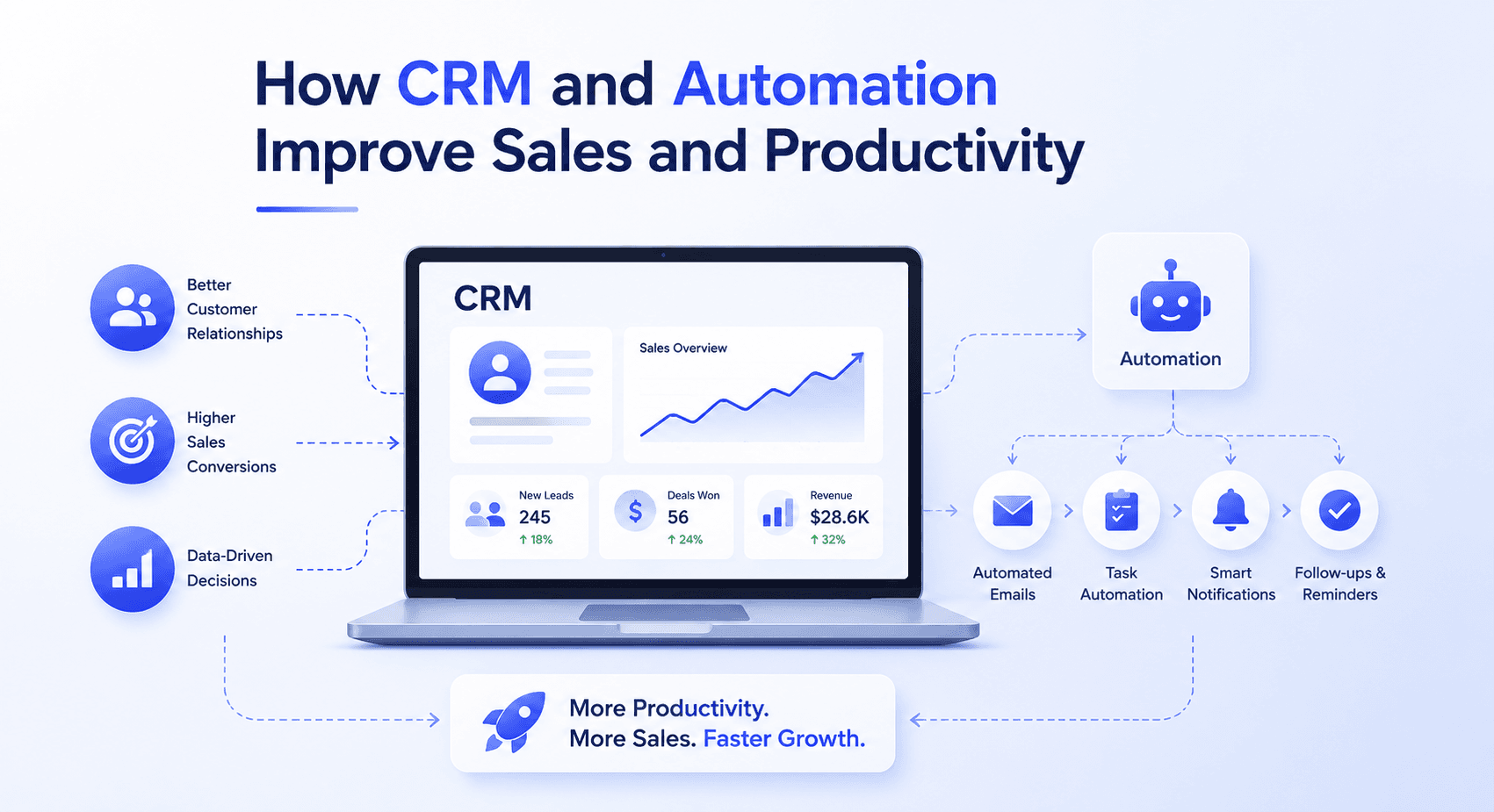
Most sales teams aren't losing deals because their product is inferior. They're losing because their process is broken — and the right CRM combined with smart automation is the most direct fix available to any business serious about sustainable growth.
There's a quiet crisis happening inside sales organizations everywhere. Reps spend hours each week manually logging calls, copying data between spreadsheets, chasing prospects who went cold, and trying to remember where exactly each deal stands in the pipeline. Managers struggle to see what's actually happening — and by the time they get a clear picture, opportunities have already slipped away. It's not a talent problem. It's a systems problem.
This is why CRM software and sales automation tools have become non-negotiable assets for competitive businesses. When implemented properly, they don't just organize your sales data — they fundamentally transform how your team operates, how leads are nurtured, and how consistently your business converts interest into revenue. The productivity gains are real. The revenue impact is measurable. And the companies getting it right are pulling decisively ahead of those still running sales on intuition and spreadsheets.
01Understanding What CRM Really Does
Customer Relationship Management (CRM) software is, at its core, a centralized system that captures every interaction your business has with leads, prospects, and customers. But that description doesn't do justice to what a well-configured CRM actually makes possible. Think of it less as a database and more as the operating system for your entire revenue function.
Before CRM, sales data lived in inboxes, notebooks, individual spreadsheets, and people's memories. When a top rep left, they often took critical relationship context with them. New hires would spend weeks just piecing together where things stood with various accounts. Managers had no reliable way to forecast the pipeline because the pipeline itself was essentially invisible.
A properly deployed CRM system solves all of this. Every call, email, meeting, and follow-up is logged and associated with a contact record. The pipeline becomes a live, searchable, filterable view that anyone with access can use to understand the state of the business. Forecasting becomes grounded in real data rather than gut feel. And when a rep transitions out, the institutional knowledge stays — because it was never trapped in their inbox to begin with.
- ⚠️Data scattered across spreadsheets and email threads
- ⚠️Manual follow-ups that fall through the cracks
- ⚠️No visibility into pipeline health or deal stage
- ⚠️Inconsistent sales process depending on the rep
- ⚠️Reporting takes hours and is often inaccurate
- ⚠️Leads go cold because response times are too slow
- ✅All customer data in one searchable, shared system
- ✅Automated sequences ensure no lead is ever forgotten
- ✅Real-time pipeline dashboards for every stakeholder
- ✅Standardized process that every rep follows consistently
- ✅One-click reports generated in seconds, not hours
- ✅Instant automated responses keep leads warm 24/7
02How Sales Automation Multiplies Your Team's Output
If CRM is the brain, sales automation is the engine. While CRM organizes information and makes it accessible, automation acts on that information without requiring manual intervention. Together, they create a system where your sales team is always working on the highest-value activities — while the system handles everything else.
Consider a typical sales workflow without automation. A lead fills out a form on your website at 11:47 PM on a Tuesday. Nobody sees it until Wednesday morning. By the time a rep sends an introductory email, it's been 14 hours — and research consistently shows that response time is one of the strongest predictors of conversion. Speed matters enormously. A prospect who hears back within five minutes is dramatically more likely to become a customer than one who hears back the next day.
Automation doesn't replace the human side of selling. It protects it — by eliminating the administrative weight that keeps sales reps from doing what they're actually hired to do: build relationships and close deals.— Sales Performance Research, 2025
With sales automation tools properly integrated into your CRM, that 11:47 PM form submission triggers an immediate, personalized response email. It adds the lead to a nurture sequence tailored to their industry or the page they converted on. It notifies the assigned rep first thing in the morning with a full context brief — the lead's company size, website behavior, and which resources they've already consumed. By the time the rep picks up the phone, they're not starting from scratch. They're continuing a conversation that automation already began.
CRM automation scores incoming leads based on behavior, firmographics, and engagement — then routes them instantly to the right rep, eliminating manual sorting and prioritization delays.
When a deal stalls, automated alerts prompt the rep to take action. Stage-based trigger sequences keep deals moving through the pipeline without requiring a manager to chase every update.
Automated CRM reporting eliminates hours of manual data consolidation. Leaders get accurate, real-time forecasts without pulling numbers from a dozen different sources every week.
03The Productivity Transformation: What Changes Day-to-Day
When companies implement CRM and marketing automation in a thoughtful, integrated way, the day-to-day experience of the sales team changes fundamentally. It's not just about saving time on data entry — though that alone is significant. It's about fundamentally reshaping how reps prioritize their work and how they show up in every customer conversation.
Without a CRM, a rep's morning might start with 30 minutes of scrolling through email threads, checking a spreadsheet tracker, and trying to remember who they were supposed to call back. With CRM automation, they open a single dashboard that shows their prioritized task list, the top leads to call based on engagement signals, and a summary of where every active deal stands. The cognitive overhead is dramatically reduced — and that mental clarity compounds into better conversations, better follow-through, and better results.
-
1Eliminate Repetitive Data Entry
Modern CRM platforms capture call notes, email interactions, and meeting summaries automatically — through native integrations with email clients, dialers, and calendar tools. Reps stop being data entry clerks and start being salespeople again.
-
2Standardize the Sales Process Across Every Rep
Automation enforces consistency. Every lead goes through the same qualification steps, every demo gets the same follow-up sequence, and every closing conversation is preceded by the same preparation checklist — regardless of which rep owns the deal.
-
3Enable Smarter, More Personalized Outreach
With full context available in the CRM — industry, company size, prior interactions, content consumed — reps can personalize every touchpoint in seconds. The prospect feels known and understood. Conversion rates reflect that.
-
4Speed Up the Entire Sales Cycle
Faster lead response, automated nurture sequences, and timely pipeline nudges combine to compress the average sales cycle. More deals close in less time — which means more revenue capacity without adding headcount.
-
5Give Management Clear, Actionable Visibility
Sales leaders can see exactly where the pipeline stands, which reps are performing, where deals are stalling, and what's at risk — in real time, without scheduled reporting calls or manual data pulls.
04CRM and Marketing Automation: Closing the Sales-Marketing Gap
One of the most damaging inefficiencies in any growth-stage company is the disconnection between sales and marketing. Marketing generates leads. Sales says the leads are bad. Marketing says sales isn't following up. The finger-pointing continues while revenue stalls. CRM and marketing automation integration doesn't just improve productivity — it resolves this structural tension at the system level.
When your CRM and marketing automation platform are properly connected, marketing can see which of their leads actually converted into revenue — not just which ones filled out a form. They can optimize campaigns based on downstream revenue outcomes rather than vanity metrics like click-through rates. Meanwhile, sales can see the full journey a lead took before they ever appeared in the CRM: which emails they opened, which pages they visited, which webinars they attended. That behavioral data is extraordinarily valuable context for the opening sales conversation.
Companies with tightly aligned CRM and marketing automation systems generate 208% more revenue from their marketing efforts, according to research from the Aberdeen Group. The data bridge between marketing campaigns and sales outcomes is where revenue acceleration happens — and where most companies are still leaving significant money on the table.
05Choosing and Implementing the Right CRM Platform
Not every CRM tool is right for every business. The market ranges from lightweight, simple-to-deploy platforms designed for small teams to enterprise-grade systems with deep customization, complex workflow automation, and extensive integration ecosystems. Getting the selection right matters enormously — a poorly fitted CRM creates as many problems as it solves.
The most common mistake companies make when choosing a CRM is over-indexing on features and under-indexing on adoption. A CRM with 200 features that your team uses only 10% of is dramatically less valuable than a simpler system that becomes deeply embedded in how your team works every single day. Adoption is everything. A CRM no one uses consistently is just an expensive address book.
-
Ease of Use and Interface ClarityThe best CRM is the one your team will actually use. If the interface is confusing or data entry feels burdensome, adoption will suffer and the investment will underperform regardless of the platform's technical capabilities.
-
Integration Depth with Your Existing StackYour CRM needs to connect seamlessly with your email client, calendar, marketing platform, customer support software, and billing system. Isolated data is almost as bad as no data.
-
Automation Capability and FlexibilityEvaluate not just what can be automated, but how easily non-technical team members can create and modify automation workflows. Complex automation that requires developer support will never be fully utilized.
-
Scalability and CustomizationChoose a platform that can grow with your business. Custom fields, stages, and reporting structures should be configurable without heavy technical intervention as your needs evolve.
-
Reporting and Analytics QualityYour CRM should make it easy to answer critical business questions: What's our conversion rate by lead source? Where are deals most commonly stalling? Which rep has the highest average deal value? The quality of your reporting directly determines the quality of your decisions.
Looking Ahead
06The Future of CRM: AI, Predictive Intelligence, and What's Next
The current generation of CRM platforms is already powerful. But the next generation — which is already beginning to emerge — integrates artificial intelligence and machine learning in ways that will make today's best practices look rudimentary. AI-powered CRM tools can already predict which deals are most likely to close based on behavioral patterns, flag deals at risk of going cold before the rep notices the warning signs, and automatically suggest the optimal next action for every contact in the pipeline.
Predictive sales analytics, powered by AI, will become the standard — not the differentiator — within the next few years. Companies that build strong CRM foundations and robust data hygiene practices today will be the ones best positioned to leverage these AI capabilities as they mature. The organizations that wait will find themselves playing a much harder game of catch-up in an already competitive landscape.
Conversational AI is also reshaping the front end of the sales process. AI-powered chat tools integrated with CRM can qualify leads, answer product questions, schedule demos, and hand off warm, pre-qualified prospects to human reps — all without human intervention for the routine portions of the interaction. This isn't a hypothetical future. It's happening in high-performing sales organizations right now.
Your Competitors Are Already Automating. The Question Is How Far Behind You'll Let Yourself Fall.
The combination of a well-configured CRM and intelligently deployed sales automation is no longer a competitive advantage — it's a competitive necessity. Businesses that have made this investment are closing faster, converting more efficiently, and scaling their revenue without proportionally scaling their headcount. The sales teams that still rely on manual processes, disconnected tools, and reactive follow-up strategies are being outpaced — and the gap widens every quarter. Implementing the right CRM and automation strategy is not a technology project. It's a revenue decision. And it's one of the most consequential decisions a growth-minded business can make. The cost of action is a few months of focused implementation. The cost of inaction is compounding, and it starts today.