The Best IT Solutions to Improve Business Performance in 2026
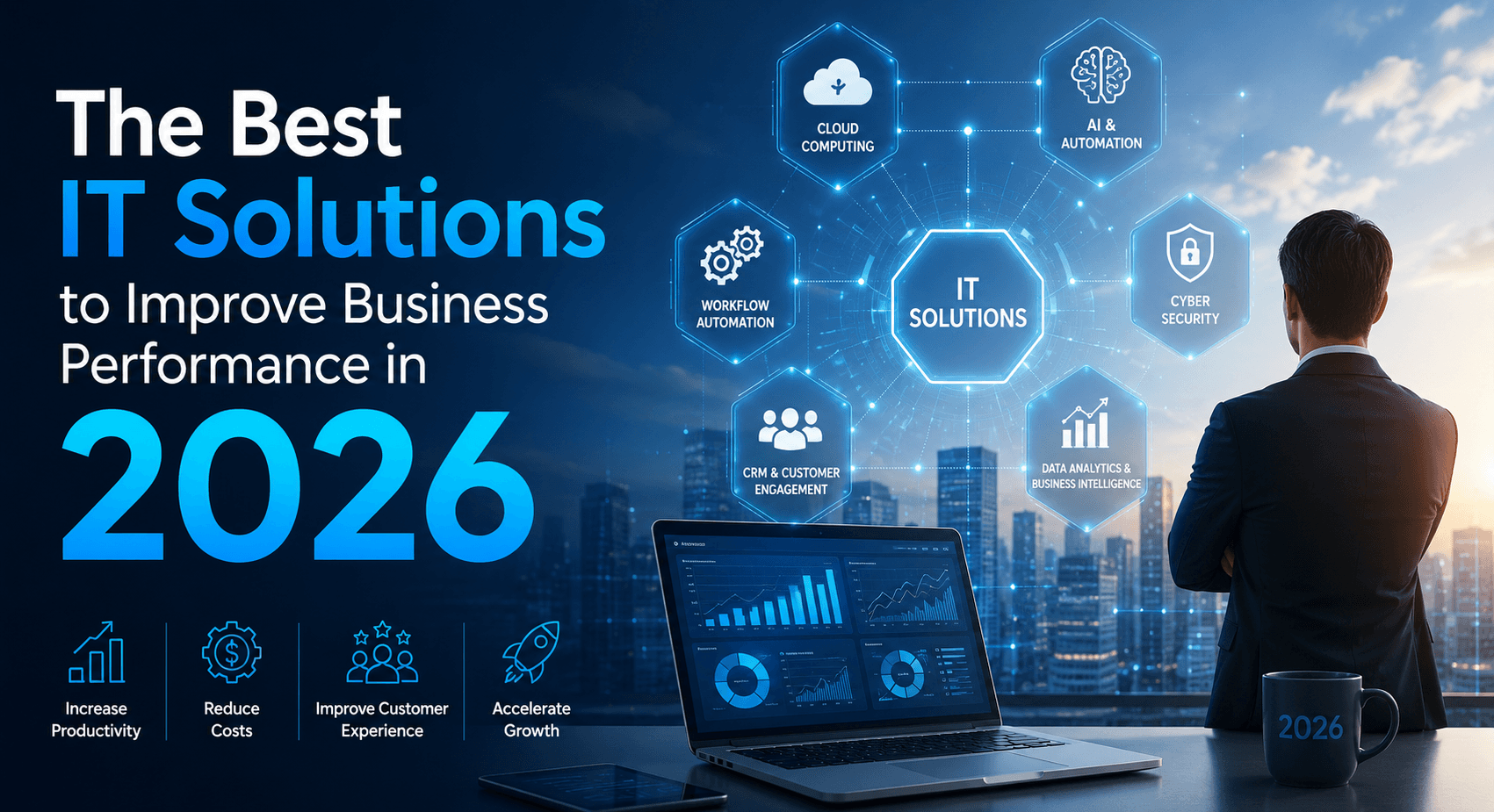
After two decades working with businesses across manufacturing, healthcare, logistics, and retail, the pattern is consistent — the gap between high-performing and average businesses almost always comes down to one thing: how well their IT systems support execution. Not how much they have spent. How well it fits.
I had a conversation recently with the operations director of a mid-size pharmaceutical distributor in Dhaka. They had invested heavily in software over the previous three years — a warehouse management system, a standalone HR platform, a separate accounting package, and a custom-built order tracking tool. Total annual spend: substantial. But their operations were slower than two years before. Their team had grown 30%, yet output per person had declined. Every week brought a new data discrepancy somewhere.
The problem was not that they had not invested. The problem was that none of the investments had been made as part of a coherent strategy. Each system solved one problem and created three new ones — in integration gaps, manual workarounds, and confused accountability. What they needed was not more IT spending. They needed better IT solutions aligned to how their business actually operates.
That distinction — between IT spending and IT solutions — is the most important concept for any business leader thinking about technology in 2026. This guide breaks down the solutions delivering measurable performance improvement for businesses right now, and how to think about deploying them in your organisation.
The Six IT Solutions Delivering Real Business Performance Gains in 2026
Not every technology category delivers equal returns. Based on real implementation experience across manufacturing, eCommerce, healthcare, logistics, and services businesses, these six solution categories are consistently producing the highest and most measurable business performance improvements right now.
Why ERP Remains the Highest-Impact IT Investment for Most Businesses
If I had to name one IT solution that consistently delivers the broadest and deepest business performance improvement across the widest range of business types, it is an integrated ERP system. Not because ERP is glamorous — it is not — but because it attacks the root cause of most operational underperformance: fragmented data and disconnected workflows.
When your sales team does not know current inventory levels, they overpromise. When your purchasing team does not see sales forecasts, they overstock. When your finance team spends a week each month pulling data from five different systems to close the books, that is a week of capacity lost to reconciliation work that should not exist. ERP eliminates all of this by building one interconnected system where every department sees the same live data.
The businesses that move fastest in 2026 are not the ones buying the most technology — they are the ones where every system works together and every person has the information they need to act without waiting for someone else to compile a report.
For growing businesses in Bangladesh, ERPNext has emerged as the most compelling option — open source, highly customisable, covers all core modules including accounting, inventory, purchasing, HR, manufacturing, CRM, and projects without per-module licensing fees. The implementation timeline for a focused SME deployment is typically 6–12 weeks, and the business impact becomes visible within the first month of go-live.
CRM and Sales Automation — Turning Every Lead into a Managed Opportunity
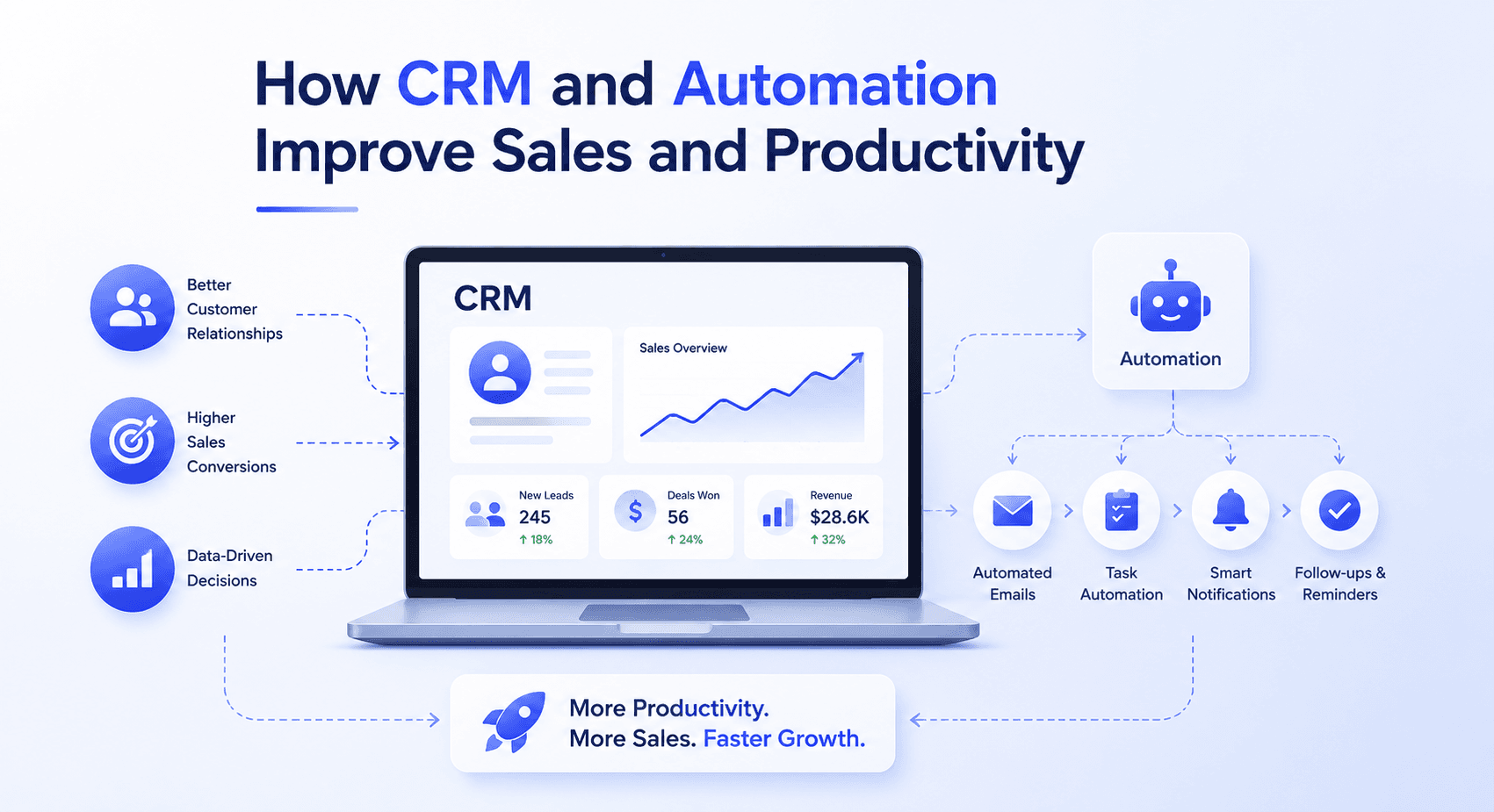
The second highest-impact solution for most growing businesses is a properly implemented CRM — and the emphasis on "properly implemented" matters because a CRM that only stores contact information is not delivering meaningful value. The performance gain comes from automation: lead capture from multiple sources, automatic assignment to sales team members, timed follow-up sequences, pipeline stage tracking, and performance dashboards that show exactly where deals are winning and losing.
Connect Facebook Lead Ads, website forms, WhatsApp Business, and email to your CRM so every inquiry enters your pipeline automatically — with no manual data entry and no leads falling through the cracks because someone forgot to add them to the system.
Trigger email or WhatsApp sequences at defined intervals after a lead enters the pipeline. A lead who does not respond to the first message gets a second three days later, a third a week after that — automatically, without your sales team having to track and remember each individually.
A live view of every deal at every stage tells your sales leadership where to focus — which deals need attention, which are stalling, and what revenue is realistically closeable in the next 30 days. This alone transforms sales management from reactive to strategic.
CRM does not stop at the sale. Renewal reminders, satisfaction check-ins, upsell triggers, and support ticket visibility all live in the same system — giving every customer-facing team member the context they need to protect and grow each relationship.
Business Intelligence — From Data to Decisions in Real Time
Most businesses are sitting on significant amounts of operational data they never actually use to make decisions. Sales happen. Invoices get paid. Inventory moves. But the reporting that would turn that activity into insight is compiled manually, takes days, and is already outdated by the time it reaches the people who need it.
Business intelligence solutions — whether the native analytics built into ERPNext or Zoho, or a dedicated BI layer like Metabase or Google Looker Studio connected to your existing databases — create live dashboards that answer the questions your leadership team asks every day without anyone having to compile anything. Revenue by product line. Customer acquisition cost by channel. Gross margin by order type. Stock turnover by warehouse location. These become one-click views rather than week-long research projects.
When your ERP, CRM, and BI tools share the same underlying data, the insight you can generate multiplies dramatically. You can see which marketing channel produces customers with the highest average order value. You can see which product categories drive repeat purchases versus one-time buyers. You can forecast cash flow based on real pipeline data rather than estimates. That level of visibility fundamentally changes how fast and how confidently a leadership team can act.
Choosing the Right IT Solutions for Your Business Stage
Not every business needs every solution simultaneously. The right sequence depends on where your biggest performance gaps are right now. Here is how to think about prioritisation by business situation and pain point:
| Business Situation | Priority Solution | Expected Impact | Timeline |
|---|---|---|---|
| Managing everything in spreadsheets | ERP implementation (ERPNext) | Single source of truth, 40–60% reporting time reduction | 6–10 weeks |
| Sales team losing leads, low conversion | CRM + pipeline automation (Zoho) | 25–35% conversion improvement, full pipeline visibility | 3–5 weeks |
| High manual workload, team working overtime | Business process automation | 30–50% reduction in manual task time per person | 4–8 weeks |
| Slow and expensive month-end reporting | Business intelligence dashboards | Real-time reporting, 70–80% time reduction | 2–4 weeks |
| High server costs and reliability issues | Cloud migration and infrastructure | 30–50% infrastructure cost reduction, better uptime | 6–12 weeks |
| Multiple disconnected systems | Systems integration strategy | Unified data flow, elimination of manual reconciliation | 8–14 weeks |
Industries Seeing the Biggest IT-Driven Performance Gains in Bangladesh
Across every industry the performance gap between IT-mature and IT-immature businesses is widening. But certain sectors in Bangladesh are experiencing particularly dramatic results right now, as digital adoption accelerates faster than the average organisation's technology planning has kept pace with.
What Good Implementation Actually Looks Like
The most common reason IT investments underperform is not the technology itself — it is how the implementation is handled. Three failure patterns repeat across businesses of every size and sector:
Starting with the tool instead of the process. Before any system is selected, the workflows it needs to support should be clearly mapped. A CRM configured for a vague sales process will underperform compared to one designed around your specific lead sources, sales stages, and follow-up cadence. The best implementations start with a process design phase before a single system is evaluated.
Under-investing in adoption. A system that 60% of the team uses inconsistently delivers a fraction of its potential value. Budget for training, designate internal champions in each department, set clear adoption metrics, and check them regularly. The gap between a 60% adoption rate and a 90% adoption rate is often the difference between a failed project and a transformative one.
Treating go-live as the finish line. The first 90 days after a system goes live are when most of the real value is either captured or lost. Users need support, configurations need adjustment based on real-world usage, and the data coming out needs active review to confirm accuracy. Post-implementation support is where the ROI is actually realised — not at the point of launch.
The businesses that will lead their categories in Bangladesh over the next three to five years are not necessarily the ones with the largest teams or biggest marketing budgets. They are the ones building the operational infrastructure — integrated systems, automated workflows, real-time data visibility — that allows them to execute faster and more reliably than competitors still running on spreadsheets and institutional memory.
In 2026, IT solutions are not a differentiator. They are the baseline infrastructure of a competitive business. The question is no longer whether to invest — it is whether to invest strategically, in the solutions that actually move the numbers, or reactively, in whatever problem feels most urgent this month.
From a full IT audit and solution mapping to hands-on ERP, CRM, and automation implementation — we help growing businesses in Bangladesh build the technology infrastructure their growth plans require, without the enterprise price tag.